
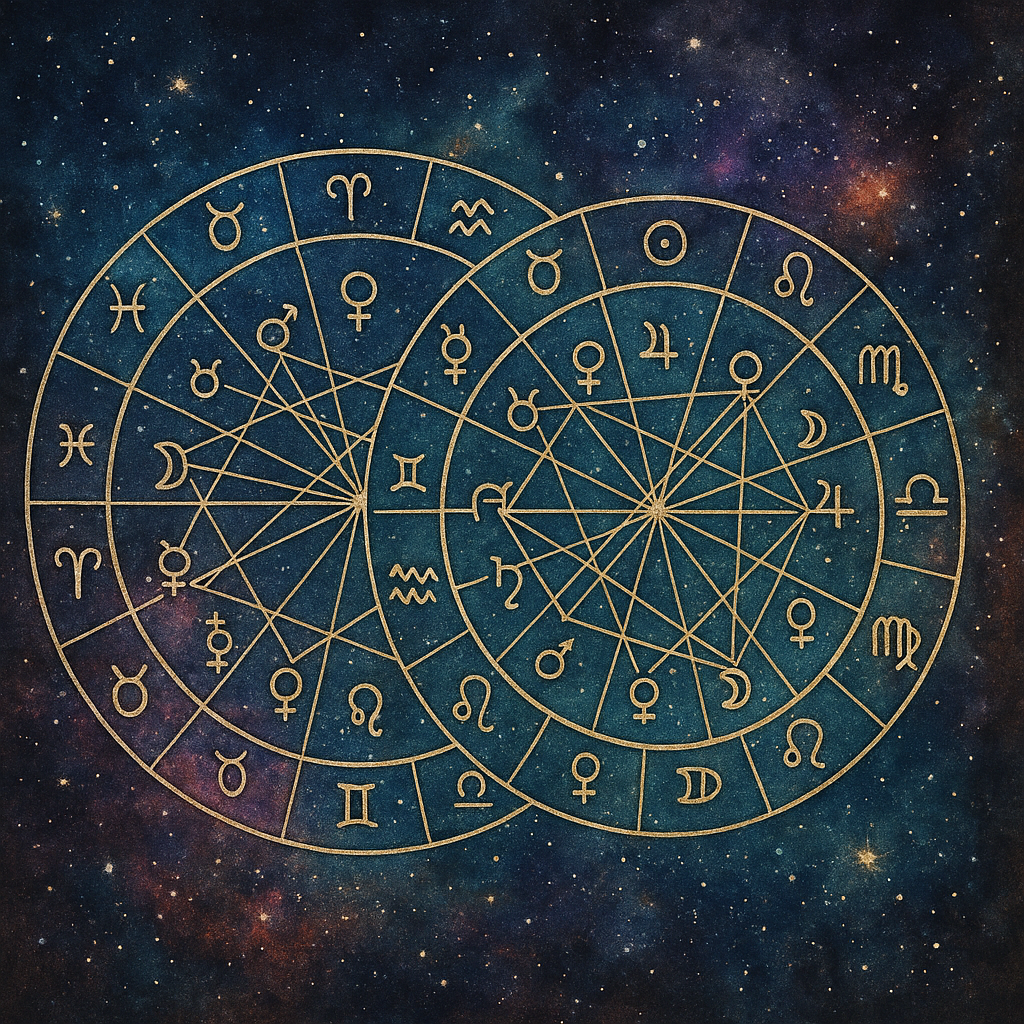
You don’t need to be a certified astrologer to read a synastry chart, although I always recommend going to one for deeper insight. Synastry charts offer many keys to understanding the dynamics in your relationships but also the impact those connections have on your development. Because many of you I know are curious about how to read a synastry chart, I put together a step-by-step guide with all the explanations you need to get going. By the end, you’ll understand how to spot attraction, emotional chemistry, communication styles, and long-term potential—all through planetary placements and interactions.
What Is a Synastry Chart?
A synastry chart is an overlay of your chart and your partner’s chart, although it can be done between you and a friend, coworker, family member, etc. As I analyze synastry charts, I’m able to understand the following aspects regarding the relationship dynamic:
- Emotional and psychological compatibility
- Sexual and romantic attraction
- Communication and conflict style
- Karmic or spiritual links
- Relationship potential (short-term vs. long-term)
Astrologers use synastry charts to understand not only the relationship between the partners but also each destiny in particular. I have to highlight that synastry charts are different than composite charts, which focus primarily on the dynamic of the partnership.
How to Read a Synastry Chart
Get in touch with me, I’ll generate it for you! You can also use one of the free (or not) synastry calculators available online. Whatever you choose, it’s important to have the birthdays, time of birth, and place of birth for both partners involved in the relationship.
Step 1: Identify the Sun, Moon, and Rising Signs
The first things you need to identify are the big three in each chart: the Sun, Moon, and Rising. These three placements can tell you a lot about each partner and the core dynamic of the relationship.
Sun-Sun compatibility: It shows if they share the same core values but also if their egos are in harmony. Here is where we can identify possible clashes or power struggles.
Moon-Moon: The synastry aspects between the moons in the two charts show the emotional rhythms and inner needs within the relationship. I look at these aspects to see if they affect the way the partners respond to each other’s emotions. Moon in the seventh house synastry, for instance, signals an intense emotional bond and karmic connection.
Sun-Moon: Aspects between the Sun and the moon are a classic compatibility indicator. Harmonious aspects (trine, sextile, conjunction) suggest emotional understanding. Squares and oppositions may bring misalignment.
Ascendant overlays: The ascendant or the rising sign shows how each person appears and responds initially. The Ascendant overlays show how one native’s planets impact the image or outward personality of their partner.

Step 2: Analyze the Aspects Between Planets
In astrology, there are five personal planets: Venus and Mars, Mercury, the Moon, and the Sun. This is not to say that the rest such as Saturn, Jupiter, Uranus, or Pluto are not important. But the personal planets and the aspects that involve them have a much bigger and often more visible impact on the relationship.
Synastry aspects are angles between one person’s planets and the other’s. These form the foundation of the relationship’s energetic dynamic. Prioritize major aspects:
Harmonious Aspects:
- Trine (120°) – natural flow, ease
- Sextile (60°) – cooperation, opportunity
- Conjunction (0°) – intensity, merged energy (a conjunct can be both positive or challenging, depending on the planets involved in the aspect)
Challenging Aspects:
- Square (90°) – tension, friction, conflict, ego clashes, struggles
- Opposition (180°) – polarity, attraction but push-pull
Key Planetary Aspects to Examine:
Venus-Mars: In relationship astrology, aspects between Mars and Venus highlight the sexual and romantic chemistry. These are the aspects in synastry that tell us if the natives are a good match. They don’t always show if the relationship will withstand the test of time or not but will offer important clues.
Moon-Mercury: You can’t learn how to read a synastry chart without looking at the relationship between the moon and the moody Mercury. These two planets tell you the emotional-mental understanding of both partners and how they relate to each other. The moon governs emotions while Mercury reigns over the intellect. Positive aspects between them show a connection with a lot of potential.
Sun-Saturn: Saturn is not a personal planet and moves quite slowly in the heavens but I never ignore it when it comes to reading a synastry chart. The dynamic between Saturn and the Sun shows commitment, responsibility, longevity, or lack of these qualities. Saturn is the taskmaker of the birth chart and it becomes the authority in the synastry chart. And the Sun represents the true identity of each native and it gives the zodiac signs of the partners.
Venus-Pluto: The aspects formed between Pluto and Venus are some of my favorites. They symbolize the intensity, transformation, obsession, and passion in a relationship. These two planets are also two extremes in the heavens so it’s fascinating when they interact. Venus is the energy of love, beauty, luxury, and peace, representing what we desire in a relationship and how we offer love. Pluto on the other hand is our mystical identity, the portal to our darkest and wildest fantasies, pushing us to stay true to ourselves and find the truth in others.
Mars-Uranus: According to astrology, the way I practice it, aspects between these two planets are the element of surprise in a relationship. They represent sexual volatility or excitement but also how the two partners maintain the spark alive in their bonding. This goes beyond the everyday relationship dynamics, it gets in the intimate energy between the natives and how they manifest it to stay engaged and invested.
Step 3: Check House Overlays
House overlays show where one person’s planets fall in the other’s chart, revealing how they affect different life areas. Understanding the dynamics at play will help you focus on those sectors in your chart that are most likely to be impacted by the relationship.
Focus on Relationship-Heavy Houses:
- 1st House: Attraction to physical presence/personality
- 5th House: Romantic fun, creativity, flirtation
- 7th House: Partnership, commitment, long-term compatibility
- 8th House: Intimacy, sexuality, transformation
Step 4: Identify Strong Synastry Patterns
While individual aspects are helpful, patterns reveal more. Look for clusters of supportive or challenging dynamics:
- Repeated trines/sextiles between emotional planets → easy, natural bond
- Multiple conjunctions → intense, possibly fated
- Hard aspects between Saturn, Pluto, and Mars → karmic lessons or control themes
Balance is key. Too many hard aspects may indicate difficulty in resolving conflict. Too many easy aspects can make things feel “flat.” Dynamic charts often combine both.
Also, look at:
- Double whammies: E.g., your Mars squares their Venus AND their Mars squares your Venus → reciprocal influence
- Recurring house themes: Are multiple planets landing in their 7th house? Relationship-heavy.
Common Pitfalls to Avoid
1. Cherry-picking aspects: Don’t fixate on one Venus-Mars conjunction and ignore a dozen harsh Saturn or Pluto aspects.
2. Assuming all “good” aspects mean a perfect match: Synastry doesn’t determine fate—it shows potential. How people show up emotionally is still the wild card.
3. Ignoring house rulers and disposition chains: These add depth and nuance. Advanced, but worth exploring.
4. Relying on astrology over reality: If someone treats you badly, no amount of trines will fix it.
Conclusion
I hope I brought some clarity on how to read a synastry chart and get away with it like a pro. However, I still recommend consulting an astrologer to unveil the dynamics in your relationship and how to maximize its potential. Applying this guide though, should give you a good view of the relationship astrologically speaking and isa great starting point for deeper investigation.
Related Reading
- How to Interpret Moon Signs in Astrology
- Understanding Black Moon Lilith in Astrology
- The Astro-Psychology Behind Zodiac Love Matches




Leave a Reply